
Customers who pass onboarding
and never
activate.
The onboarding checklist says 100% complete. The 90-day health check shows they're using one feature. Renewal arrives in month ten and they ask for a discount because they "don't use it that much." The onboarding design — not the product — is the variable.
The competitive question the AE couldn't answer
A new AE is six weeks into ramping. Product training done. Battle cards read. Two calls shadowed. Third solo discovery call — a prospect she's been working to schedule for two weeks.
The prospect says: "We looked at Competitor X — why should we choose you?" She has the answer. Then the prospect asks about a specific technical integration Competitor X supports. She doesn't know the answer. "I'll check and come back to you."
The prospect never schedules the follow-up. The deal is lost — not because of the knowledge gap, but because the moment she said "I'll check," the prospect's confidence left the call. A battle card answer and a live call are different skills.
Competitive and technical depth is the hardest knowledge to build through shadowing. It requires structured learning against specific scenarios that AEs will face in live calls — not another deck, another read-through, another "you'll pick it up as you go."
What knowledge gaps cost a SaaS revenue operation
Revenue lost at each stage of the enablement failure chain — from activation gap to expansion miss
What changes when knowledge is built for decision-making, not recall
- Customers complete the onboarding checklist — all calls attended, all videos watched
- Internal teams read the battle card, shadow a call, attend a product session
- Knowledge is passive — recalled when prompted, not applied under pressure
- Gaps surface in a live call, a renewal conversation, or a support ticket queue
- Remediation is human — another CSM call, another onboarding session
- Customers and internal teams make decisions — in role-specific scenarios they'll face in practice
- Wrong paths are experienced safely — before the live call, the renewal, the competitive question
- Completion records show applied knowledge — not attendance
- Multiple certified users per account — institutional knowledge is distributed, not concentrated
- CSM time shifts from product education to strategic relationship work
Handling "Why Not [Competitor]?" — The Competitive Response Framework
The question that appears on almost every mid-to-late-stage discovery call — and that AEs lose deals by answering wrong, or not answering at all.
The four-step competitive response framework — Acknowledge, Clarify, Position, Confirm. Why each step exists. Why dismissing a competitor backfires in a B2B discovery call. The specific language patterns that signal confidence versus defensiveness to a prospect.
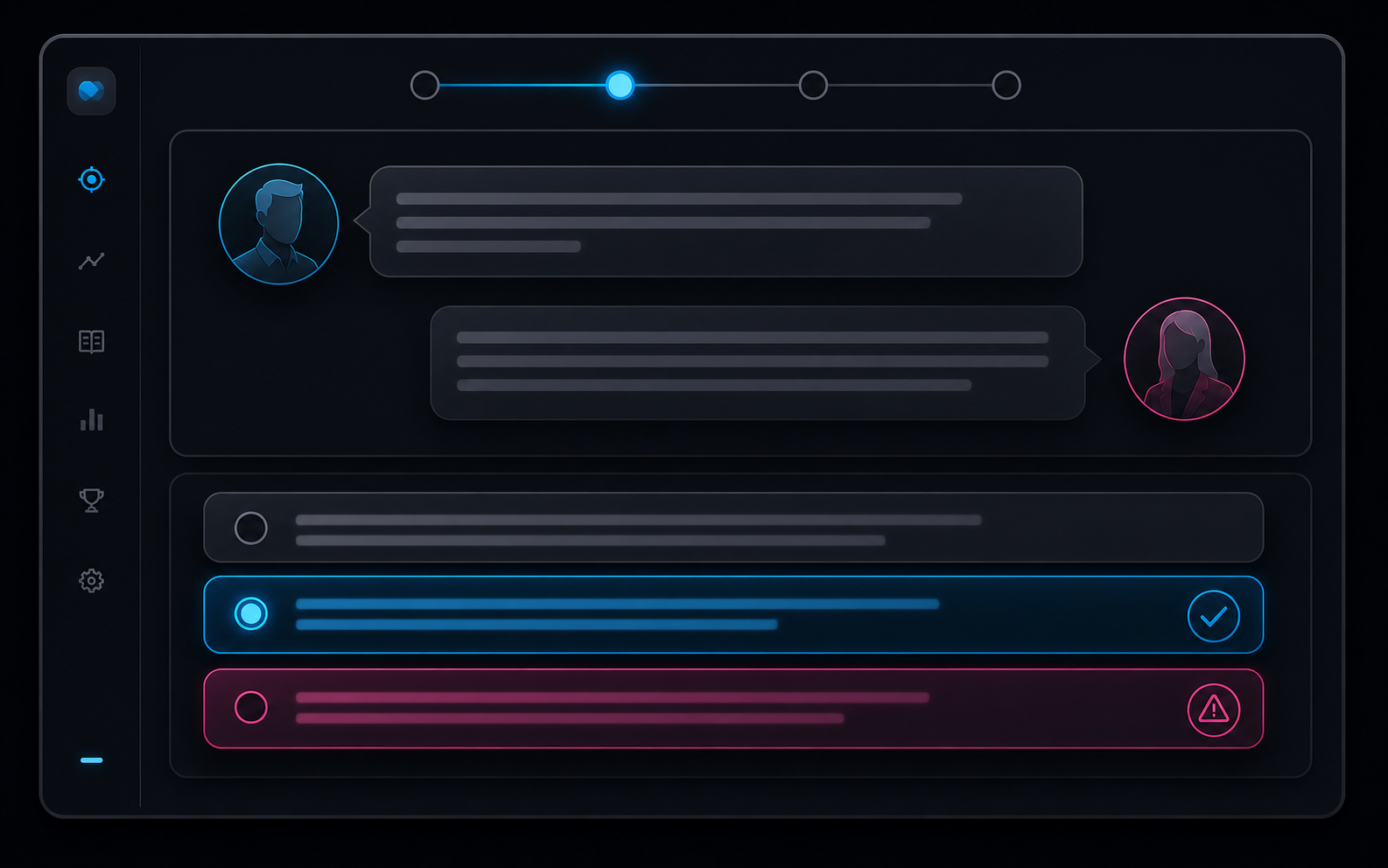
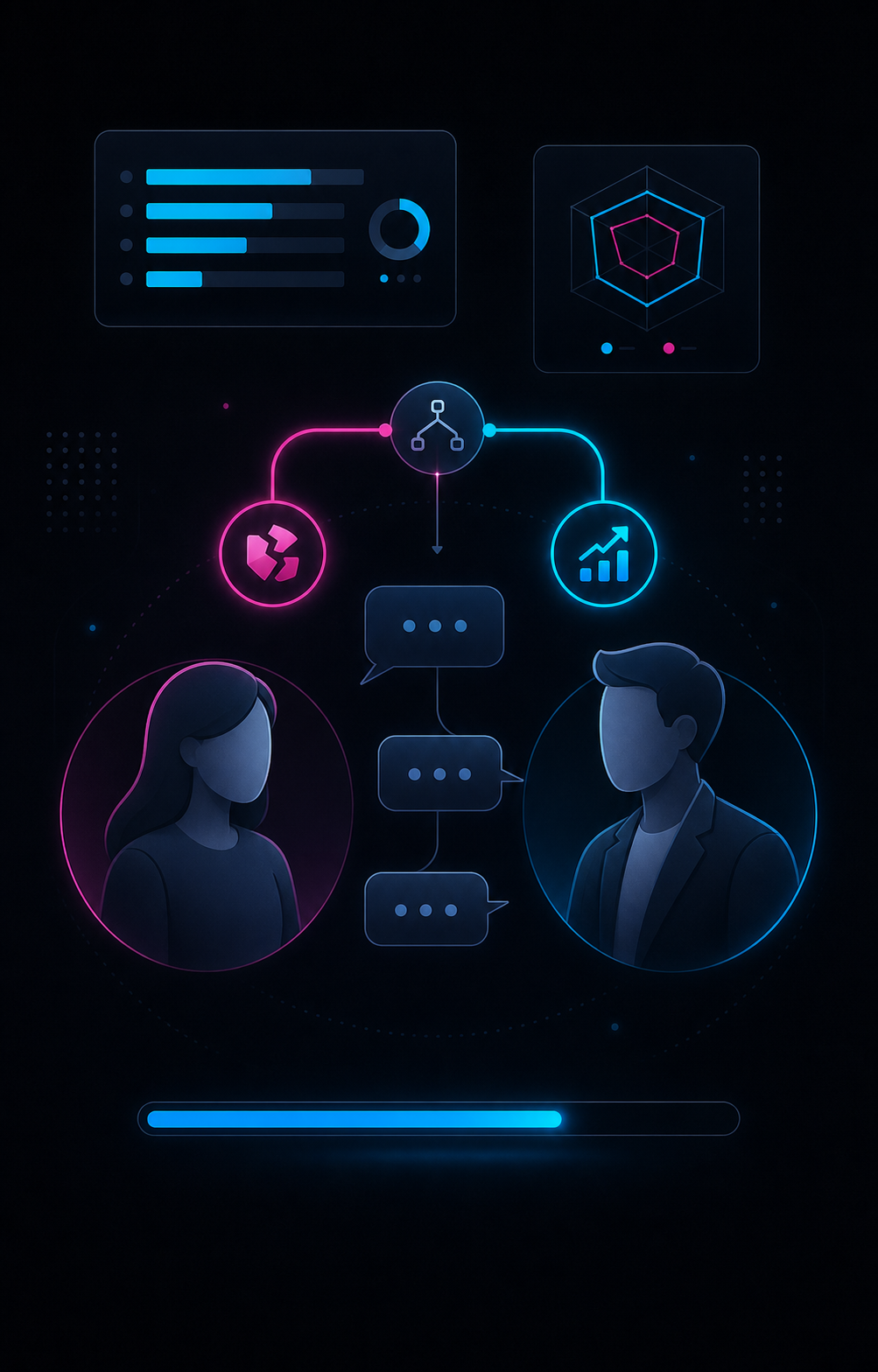
A prospect on a discovery call names your top competitor. The AE navigates the conversation at five decision points: acknowledge the comparison, ask a clarifying question that reveals the real decision criteria, reframe the comparison, handle the follow-up technical question. Wrong paths show the prospect becoming defensive; correct paths move toward the next step.
A late-stage prospect emails after a competitor demo: "They showed us X that you don't have." Three response options — with consequence scenes for each. The email draft that wins and the email draft that loses the deal are separated by two sentences.
The three sentences you should never say about a competitor — and the exact alternatives. AEs leave with a framework they can apply in the next live call, not a list of claims to memorise from a battle card.
Every SaaS enablement problem has a module
Each module addresses a specific, named scenario from the customer success, revenue, and partnerships playbook — built around decision-making, not feature awareness.
CSM detects three early churn signals in her account portfolio — but can't prioritise the right intervention for each
Reading the Early Churn Signals in Your Portfolio
A QBR becomes a feature review session and the renewal conversation never opens
Conducting a QBR That Drives Expansion, Not Just Renewal
Customer-facing teams handle personal data in CS workflows without understanding which actions constitute GDPR violations
GDPR Data Handling for Customer-Facing Teams
Channel partners are trained on v2.8 — your product is on v3.4 and the reporting module was rebuilt
Partner Certification: Delivering Your First Product Demo
78% of accounts use the three features from onboarding. The features driving 60% of expansion revenue have 11% adoption
Feature Adoption Campaigns: Framing the New Capability as a Workflow Solution
The enterprise champion who drove expansion from 20 to 80 seats left — her replacement started from zero in December
Customer Certification Programme: Distributing Product Knowledge Across the Account
300 support tickets in the week after a major UX release — 80% asking 'I can't find X anymore'
Product Release Readiness: Pre-Update Navigation Module
Partner-onboarded customers generate 30% of new logos but 8% of expansion revenue — the knowledge depth gap
Partner Onboarding: Building the Product Depth Your Channel Needs
New AEs complete product training and shadow calls — but can't handle the specific competitor comparison on a live discovery call
Full Sales Simulation: A New AE's First Solo Discovery Call
See it in your product context before you commit
One complete module built around a specific problem in your CS, sales, or partner motion. Delivered in 10 business days for $5,000.
- One module · up to 30 minutes
- Built to your product, your personas, your competitive landscape
- Scenario-based assessment — not a feature knowledge quiz
- SCORM 1.2 or SCORM 2004 (your choice)
- Hosted learner link for immediate deployment
- All source files — you own everything
- ✓ 1 module · up to 30 min
- ✓ SCORM 1.2 or 2004
- ✓ Professional AI narration
- ✓ Hosted learner link
- ✓ All source files
- ✓ One round of revisions
What SaaS revenue and success leaders usually ask
Can you build training for multiple roles — CSMs, AEs, and partners — from the same content source?
Yes. We build role-specific variants from the same underlying product knowledge. A CSM module covers churn signals and expansion conversations. An AE module covers competitive objection handling and discovery structure. A partner module covers demo certification. Same product, different scenarios, different outcomes — built in parallel rather than separately.
How do you handle product updates without rebuilding modules from scratch?
We build to a modular structure so updated sections can be swapped without rebuilding the whole module. For significant releases, we produce pre-release navigation modules — short, scenario-based walkthroughs of what changed — that turn a confusion event into a confidence event. These can be turned around in 3–5 business days.
Our product is technical. Can your modules cover implementation depth, not just feature awareness?
Technical depth is where simulation-based training has the greatest advantage over documentation and passive walkthroughs. We build interactive procedural stages — where learners complete real tasks in a simulated environment — combined with branching scenarios covering technical decision points. The result is demonstrable applied knowledge, not awareness.
What does a customer certification programme look like in practice?
It's a structured set of modules — typically 4–8, covering core workflows, advanced features, and role-specific use cases — with a verified assessment at each stage. Completion generates a timestamped, named record of who in each account is certified, at what level, and when. This is the institutional knowledge distribution layer that protects accounts from single-champion dependency.
Brief us on your specific SaaS enablement problem
Customer activation, churn prevention, AE ramp, competitive handling, partner depth, feature adoption — or something else. We build to your product, your personas, and the specific decisions your people need to make well.
Get started — $5,000 pilot