Logistics & Warehousing

A logistics training failure
has a citation number.
Or a shipment number.

OSHA doesn't issue citations to "the training programme." They issue them to your facility, on a document with your name on it. And insurance underwriters want the same timestamped competency record the inspector does. One is a fine. The other is your renewal rate.

Built for: VP of Operations Director of EHS Head of Training Supply Chain Director
logistics-hero-visual.png /public/images/industries/logistics/
Logistics warehouse training simulation showing OSHA inspection checklist interface
OSHA-compliant
Timestamped assessment records
10 business days
Delivery guarantee
$15,625 OSHA penalty per willful violation in 2024. A forklift inspection non-compliance finding can generate 5–9 citations from a single audit
$84,425 Median direct cost of a warehouse forklift incident in the US — before lost productivity, insurance premium increase, or legal exposure
90 days Average time from a corrective action finding to documented re-training completion — when training is delivered via traditional instructor-led methods
A warehouse that failed its inspection

The 9 OSHA citations from one warehouse inspection

The programme

A third-party logistics facility operates a documented forklift safety training programme. New operators complete a classroom session, sign the acknowledgement form, and are cleared for independent operation within five days of joining.

The gap

Pre-operation inspection checklists are completed daily. Closer review shows 84% of the checklists are identical across operators and shifts — the same fields ticked, the same boxes checked. Experienced operators have learned which fields the supervisors review; the rest are treated as administrative overhead.

The inspection

An OSHA compliance officer arrives unannounced. The walkthrough takes four hours. The inspector observes two active pre-operation inspections, reviews twelve months of completed checklist records, and interviews three operators on their understanding of load capacity ratings.

The citations

Nine citations. Three willful. $140,625 in proposed penalties. The corrective action plan requires documented re-training for all 34 powered industrial vehicle operators — with individual competency records demonstrating applied knowledge, not attendance. The form the facility has been using is explicitly insufficient.

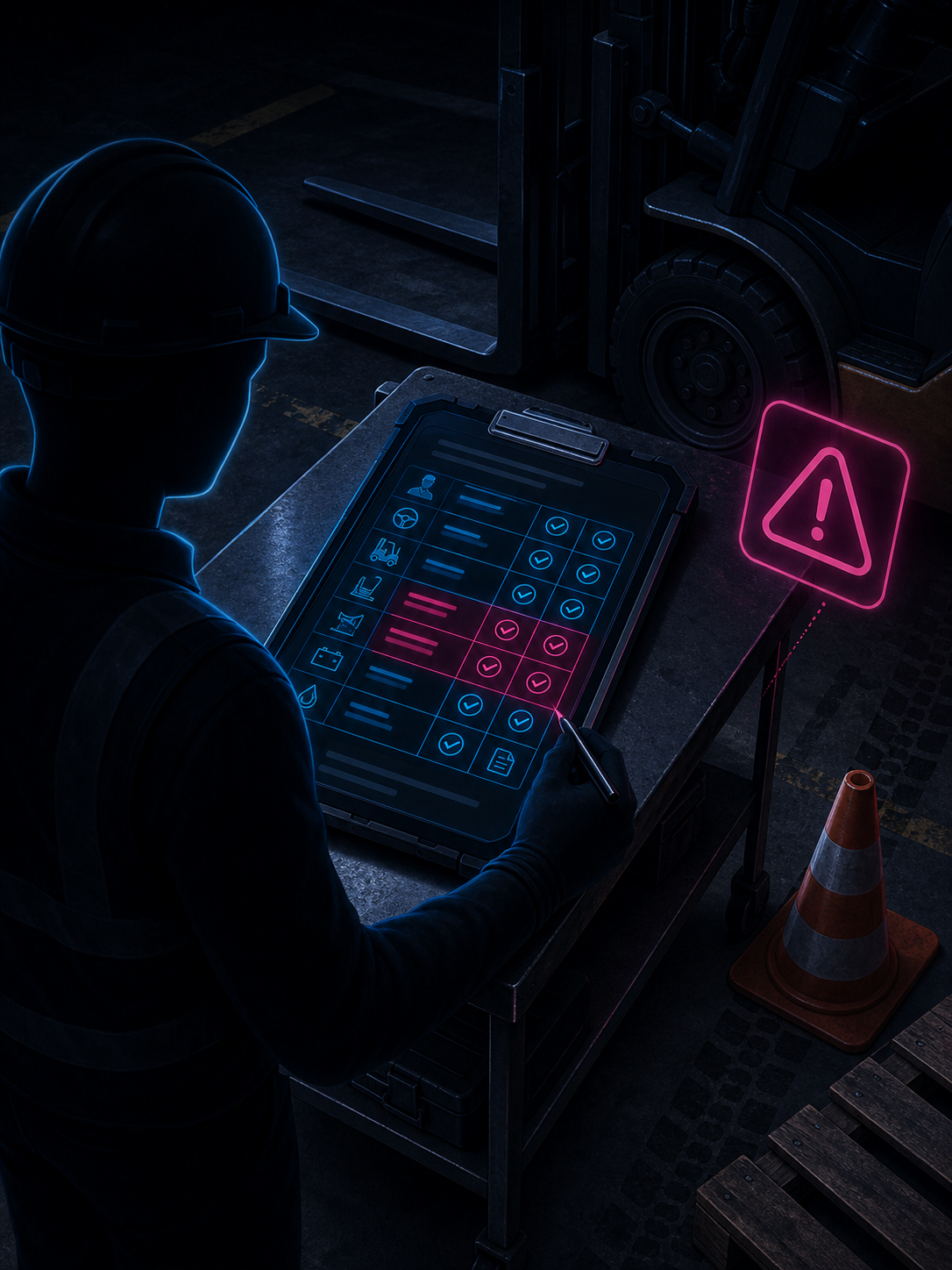
logistics-incident-scene.png /public/images/industries/logistics/
OSHA inspector reviewing warehouse forklift inspection records
9 willful violations $140,625 fine exposure from a single OSHA inspection
The real cost

What a single inspection failure costs a logistics operation

From direct fine exposure to downstream operational and commercial impact

$140k+
OSHA fine exposure
proposed penalties from 9 citations — 3 willful at $15,625 each, 6 serious
3 days
lost capacity
average PIV downtime while corrective action training is completed and documented
4 hrs
management time
per operator to build an individual re-training record that satisfies the CAP documentation requirement
30%
insurance premium
typical workers' comp premium increase following a willful OSHA finding
Compliance gap
Financial exposure
The difference

What changes when safety knowledge is built for applied practice, not form completion

Standard safety training
  • Operators complete classroom sessions and sign acknowledgement forms
  • Pre-operation checklists are completed as administrative routine, not genuine inspection
  • Complacency in tenured operators is assumed and accepted
  • An incident occurs — retraining is initiated with no individual competency record
  • The OSHA corrective action plan requires documentation the facility cannot produce
vs
Simulation-based safety education
  • Operators make the inspection decisions — in simulation, under the same time pressure as real conditions
  • Complacency is specifically addressed: branching paths show what a complacent checklist produces
  • Individual SCORM completion records with timestamped scores exist before an inspector arrives
  • Re-training after an incident takes hours, not weeks — and generates audit-ready documentation
  • The corrective action plan has a training response ready before the citation arrives
Sample module — anchor use-case

Forklift Safety: OSHA 29 CFR 1910.178(l) Pre-Operation Inspection

The regulation that generates the most warehouse citations — and that most facilities believe they've already trained for, until the inspector asks an operator to explain what they're checking and why.

CA
0–3 min Concept Animation
HS
3–8 min Hotspot Explorer
BS
8–12 min Branching Scenario
PS
12–17 min Procedural Stages
AD
17–20 min Assessment + Debrief
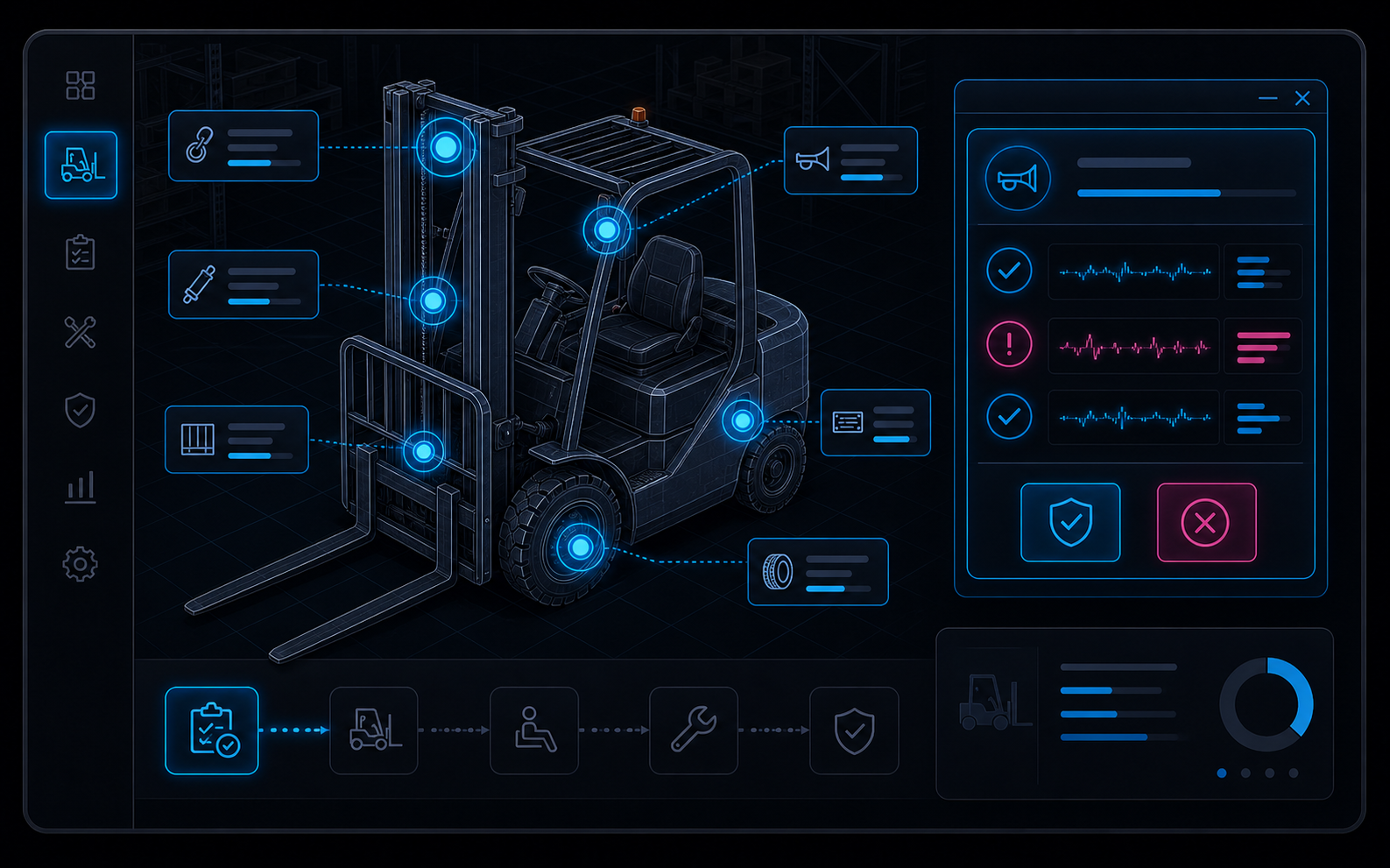
logistics-course-preview.png /public/images/industries/logistics/
Forklift pre-operation inspection simulation module with hotspot interactive checklist
20 minutes
SCORM 1.2 or 2004
Applied competency assessment
0–3 min
Concept Animation

Why pre-operation inspections exist as a legal requirement — not a paperwork exercise. The direct line from a missed inspection item to a tip-over incident to the OSHA citation number. What "willful" means in the context of an operator who has completed inspection training but still skips steps.

3–8 min
Hotspot Explorer

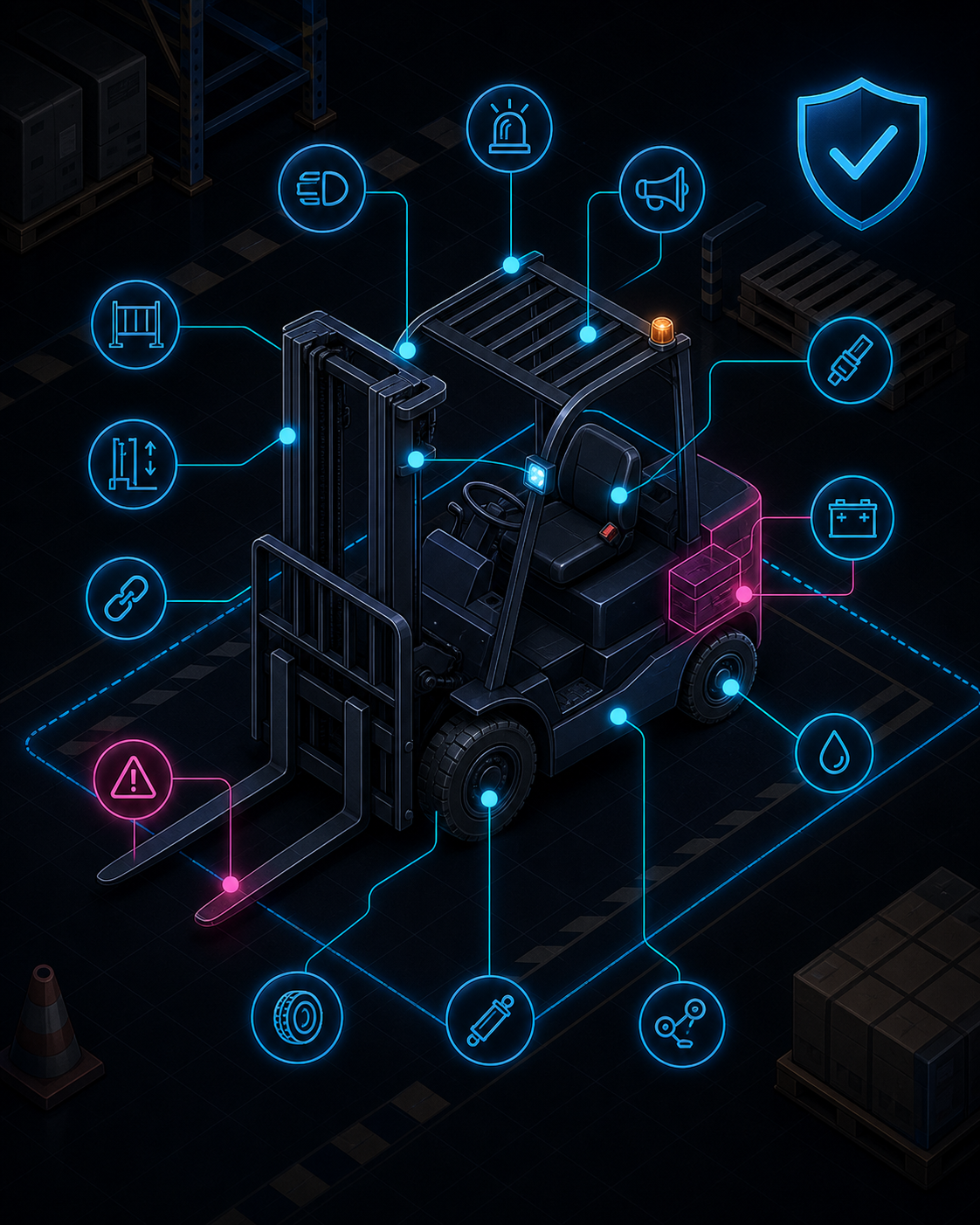
A detailed visual of a sit-down counterbalanced forklift with 14 interactive inspection zones. Each zone requires the operator to identify the correct inspection action, the pass/fail threshold, and the removal-from-service trigger. Not a checklist to tick — a decision environment that requires applied knowledge at each point.

8–12 min
Branching Scenario

An experienced operator completes the daily inspection at the start of a busy shift. At three points, the scenario presents a borderline condition — a hydraulic fluid level near minimum, a tyre with visible wear but no flat, a horn that works intermittently. Two paths: document and remove from service vs. note and continue. Consequences play out across both paths before the debrief.

12–17 min
Procedural Stages

Step-by-step completion of the pre-operation form — with the specific fields, the specific language, and the specific documentation standard that satisfies OSHA's 29 CFR 1910.178(q) record-keeping requirement. Operators complete the form in the simulation, with immediate feedback on each field entry.

17–20 min
Assessment + Debrief

Five scenario-based questions covering the three borderline conditions from the branching scenario, plus two novel situations. Completion generates a timestamped individual record with score. The debrief surfaces the three most commonly skipped inspection points across facilities — and why skipping them is a willful violation pattern, not an oversight.

Commission this module for your facility Or brief us on a different compliance gap — hazmat, cold chain, WMS, cycle count accuracy, last-mile delivery
More from the logistics module library

Every logistics and warehousing training problem has a module

Each module addresses a specific, named scenario from the operations, EHS, and supply chain playbook — built around applied decisions, not regulatory text summaries.

An operator conducting a forklift pre-operation inspection skips three checks because the form looks identical to yesterday's and nothing went wrong

Forklift Pre-Operation Inspection: OSHA 29 CFR 1910.178(l) Compliance Check

Investigation20 min

A new warehouse associate is trained on the WMS during onboarding but mis-picks at a rate 4× higher than experienced staff for the first 60 days

WMS Navigation: Locating, Confirming, and Processing a Mixed-SKU Pick Order

Hotspot Explorer20 min

A driver accepts a shipment with visible damage to outer packaging and completes delivery without noting the exception — the insurance claim is denied

Accepting and Documenting a Damaged Goods Exception at Point of Receipt

Procedural Stages20 min

A loading dock supervisor allows stacking heights that exceed floor-load ratings because no one ever calculated the actual number

Load Calculation and Stacking Compliance: Floor-Load Ratings in Shared Dock Space

Branching Scenario20 min

A cold-chain temperature excursion happens at handoff because the receiving team assumes the outbound team confirmed the pre-cool cycle

Cold Chain Integrity: Temperature Verification at Transfer Points

Sequence Order20 min

Last-mile drivers are completing proof of delivery incorrectly — 12% of deliveries require re-contact within 48 hours

Last-Mile Delivery: Completing Proof of Delivery for Contactless and Signature Stops

Character Dialogue20 min

A hazmat shipment is labelled correctly at origin but the document set is incomplete — the carrier rejects it at the hub at 11pm

Hazmat Documentation: Building a Complete Document Set for Ground Transport

Document Annotation20 min

Cycle count accuracy is 94.3% — the 5.7% discrepancy maps almost entirely to three SKU families and one shift

Inventory Accuracy: Cycle Counting Protocol and Discrepancy Investigation

Investigation20 min

A new operations supervisor conducts their first OSHA 1910.22 walkthrough — they identify 3 of the 11 hazards the inspector will cite four months later

Full Inspection Simulation: OSHA General Industry Walkthrough for Operations Supervisors

Full Simulation30 min
The pilot

See it at your specific regulation and facility context before you commit

One complete module built around a specific OSHA regulation, operational procedure, or compliance gap at your facility. Delivered in 10 business days for $5,000.

  • One module · up to 30 minutes
  • Built to the specific regulation, procedure, and facility context you specify
  • Scenario-based applied competency assessment — generates individual SCORM records
  • SCORM 1.2 or SCORM 2004 (your choice)
  • Hosted learner link — deployable immediately on any device
  • All source files — you own everything
Request your logistics pilot
Pilot
$5,000
one-time · 10 business days
  • 1 module · up to 30 min
  • SCORM 1.2 or 2004
  • Professional AI narration
  • Hosted learner link
  • All source files
  • One round of revisions
Operations and EHS questions

What logistics and warehousing leaders usually ask

Can modules be built to specific OSHA regulation numbers, not just general safety topics?

Yes — and that specificity is the point. A module built to 29 CFR 1910.178(l) covers the exact inspection checklist, the exact consequence structure, and the exact decision points that appear in an OSHA audit. Generic 'forklift safety' training does not protect you in an inspection. Regulation-specific simulation does. We build to the citation, not the category.

Our operations run 24/7 across multiple sites. How do we deploy without disrupting shift schedules?

Modules are SCORM-packaged and accessible on any device — mobile-first for floor teams who may not have desk access. A 20-minute module can be completed during a scheduled break or pre-shift briefing window. For multi-site deployment, a hosted learner link works independently of your existing systems until you're ready to integrate via LTI or SCORM import.

We have a mix of tenured staff and high-turnover roles. Can the same module work for both?

We build branching structures — where tenured staff can move through known material faster while new hires work through more scaffolded decision points. A single module can serve both, with completion records distinguishing who needed which path. Branching also means complacency — the biggest hazard risk with tenured operators — is specifically addressed, not assumed away.

What does an audit-trail record actually look like, and who can access it?

SCORM completion data captures: learner name, completion date, score, and time-on-task — at the individual level. This is the timestamped competency record that satisfies both OSHA corrective action documentation requirements and insurance underwriter requests. The data lives in your LMS or in our hosted environment, accessible on-demand. Export is available in CSV or standard SCORM reporting formats.

Brief us on your specific compliance or operations training problem

Forklift safety, hazmat documentation, cold chain, WMS adoption, last-mile delivery, cycle count accuracy — or something else entirely. We build to the specific regulation, procedure, and facility context you're operating in.

Get started — $5,000 pilot